





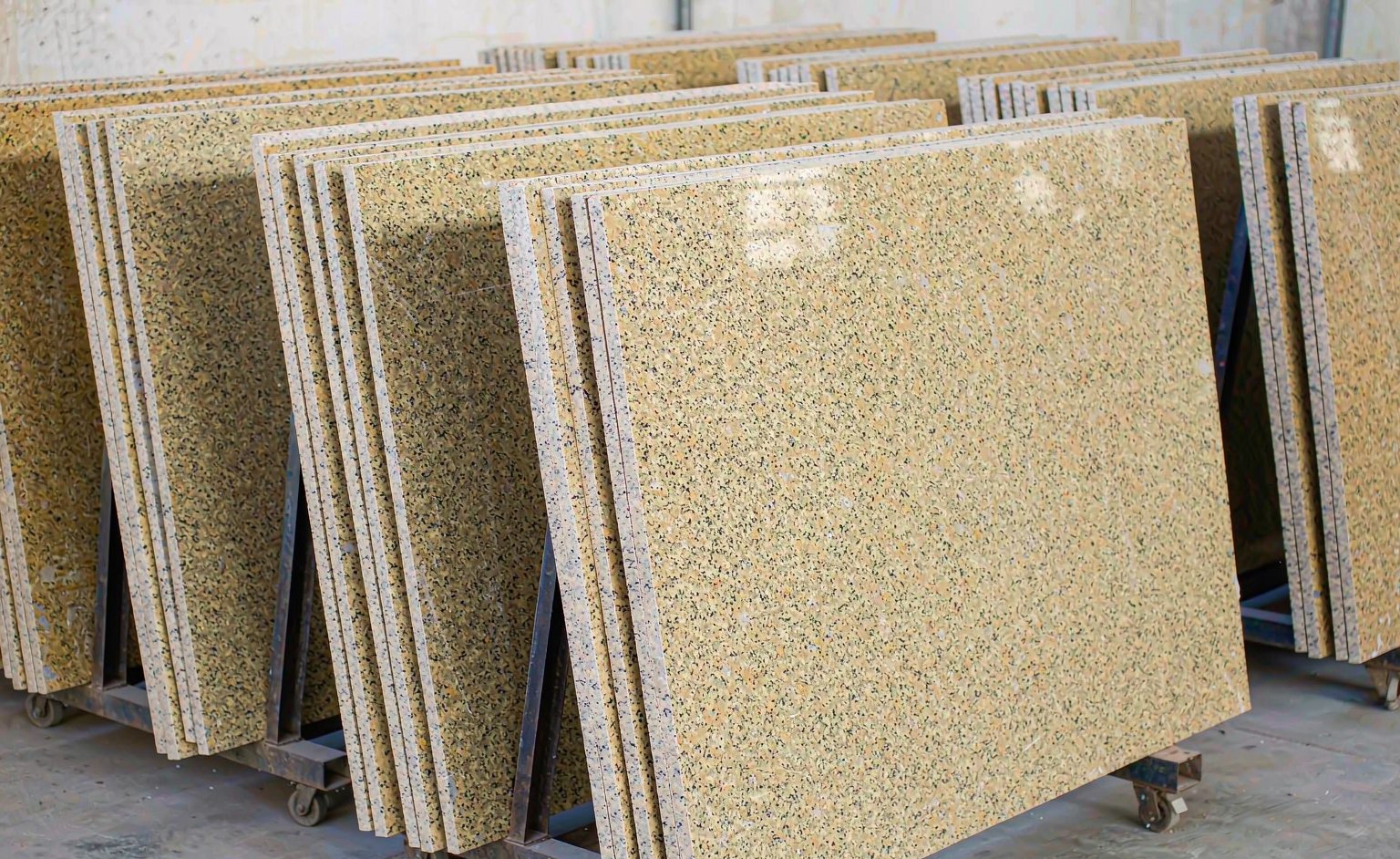
Ask three suppliers to price the same G682 golden granite cladding package and you will get three numbers that differ by forty percent or more. Ask what sits inside those numbers and the conversation usually goes quiet. For a developer or an owner’s representative comparing facade options, the square-metre rate is the least useful figure on the table until it is broken into the parts that drive it.
What the Square-Metre Rate Actually Contains
A supply-and-fix price is a stack of separate costs:
- Block cost and yield. How many usable panels come out of a cubic metre depends on the cutting plan, vein direction and the natural fissures in each block.
- Processing. Polished, honed and flamed surfaces run on different lines, then squaring, calibration, edge profiling and anchor drilling follow – finish and fabrication are both cost decisions, not only aesthetic ones.
- Testing and documentation. Water absorption, flexural strength, freeze-thaw and radiation classification (GB 6566 Class A where interiors are involved) are charged per batch – but they are in the price.
- Packing and freight. Seaworthy crates and cubic metres on the vessel. Stone is priced by weight and volume, so freight takes a larger share of a granite facade than of a glass one.
- Installation. Brackets, rails, sealant, scaffolding, access equipment and labour – usually the largest single line, and the one most often missing when a supplier quotes for “facade stone” alone.
The Five Variables That Move the Number Most
- Thickness. 30 mm is the working default for ventilated dry-hung facades. At a density of about 2.7 g/cm3, a 30 mm panel weighs roughly 81 kg per square metre; 40 mm adds around 27 kg, which multiplies through brackets, rails and the structural frame. Specify thicker only where the design demands it.
- Module size. Panels aligned with the block’s natural yield – modules in the 600 to 900 mm range against 1.8 to 2.0 m block heights – cut waste sharply. Oversized feature panels are possible in G682, but you pay for the offcuts.
- Finish mix. Every extra finish means a separate production run, separate packing and another colour batch to reconcile. One finish across the main elevations, with flamed surfaces reserved for podium and paving, is materially cheaper than four.
- Edge and soffit work. Exposed returns, drip grooves and soffits are slow, hand-heavy operations; designing them out of the typical bay saves more than any rate negotiation.
- Spares. Budget three to five percent spare panels at order stage; buying them eighteen months later means a new production run and a colour match that is never exact.
Why the Cheapest Panel Rate Is Rarely the Cheapest Facade
The low quote usually wins on one line and loses on three: a nominal thickness measured at the bottom of tolerance, a breakage allowance that quietly excludes transit damage, and a production slot that slips once the order is confirmed. On a tower, a four-week slip on stone delivery costs more in extended scaffolding and crane time than the gap between the cheapest and the median panel rate. Durability is the other half of the equation. G682’s compressive strength of 110 to 150 MPa, water absorption below 0.4 percent and freeze-thaw resistance beyond 200 cycles are what let a facade reach twenty-five years with nothing more than cleaning and periodic repointing.
Where Developers Can Legitimately Save
- Standardise the module across all elevations and let the block yield set the panel size, rather than forcing a drawing module the block cannot produce efficiently.
- Consolidate the order. Facade panels, podium paving, steps and kerbs in the same G682 batch and the same container reduce colour risk and freight cost per square metre.
- Buy from the quarry owner. Every intermediary adds a margin and a handling step without adding to the stone.
What to Budget After Handover
Granite has no coating to renew and no colour to fade. Plan for cleaning once or twice a year depending on dust and salt exposure, sealant joint replacement at eight to ten years, and anchor inspection at the same interval. Against the recoating cycle of a painted rainscreen, the whole-life case for stone turns on maintenance rather than first cost.
A Practical Way to Compare Two Quotes
Ask every supplier for the same breakdown: block and yield, processing, testing, packing, freight to port and installation – stated separately, with thickness tolerance, finish, module size and spare allowance written down. Two quotes built on identical line items can be compared in an afternoon; two lump sums cannot.
Suizhou Xuhui Stone operates its own quarry and processing plant in Hubei, producing G682 golden granite and G603 white granite for facades, paving and landscape work. Send us a facade drawing or a schedule of areas and we will return a costed breakdown on that structure, line by line.
Leave a Reply