





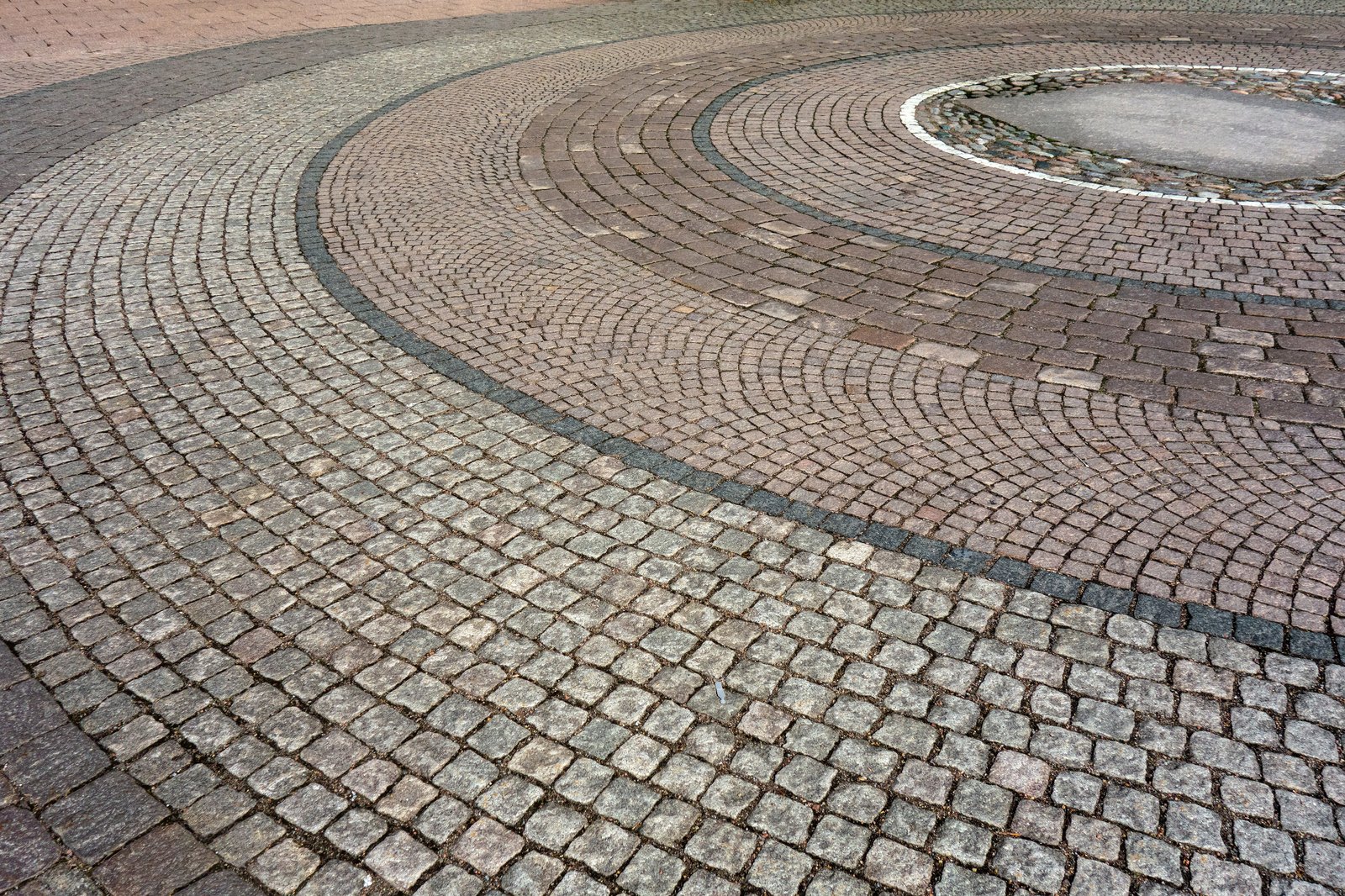
Horizontal stone lives a harder life than facade cladding. A wall panel mostly has to hang there and look good; a plaza paving unit has to survive foot traffic, forklift wheels, de-icing salt, standing water and, in northern climates, hundreds of freeze-thaw cycles. Landscape and municipal projects therefore fail differently from facades, and the details that matter for G682 golden granite paving differ accordingly. This guide covers the decisions that determine whether flamed granite still looks right in year ten.
Why Flamed Finish Is the Default Underfoot
Polished stone underfoot is a slip hazard waiting to happen. Flaming — passing a high-temperature flame across the surface so quartz crystals micro-fracture and pop — produces the rough, matte texture that keeps granite slip-resistant even when wet. For pool surrounds, fountain copings, ramps and any hosed or rained-on surface, flamed is not a style choice; it is the safety specification. Approving samples is simple: a wet fingertip should feel distinct crystalline grip, not a slightly rough polish. Flamed G682 also turns a lighter, softer gold than polished stock — so approve samples in the finish you actually specified.
Thickness: Match the Load, Not the Lowest Price
The most expensive mistake in landscape stonework is buying paving thickness from a catalogue instead of from the traffic plan. Our working recommendations for G682:
- 30 mm — pedestrian plazas, walkways and garden paths laid on a full mortar or sand-cement bed
- 50 mm — light vehicle areas, residential driveways and podium levels with occasional maintenance traffic
- 60 mm and above — public carriageways, parking bays, kerb-adjacent turning areas, or any unit set on sand bedding
Thin panels bonded to a sound substrate can work in raised pedestal systems, but on conventional bedding, thickness is what converts point loads into distributed load. A quote that quietly drops 50 mm units to 30 mm “equivalents” transfers the risk to you.
Steps, Kerbs and Coping: The Details That Get Value-Engineered Out
Vertical-facing details carry the visual weight of a landscape scheme — and they expose fabricator capability. Three details worth locking into the drawing set early:
- Step treads: specify a flamed or honed top with a slightly eased or bullnosed front edge; a crisp sawn arris on a public staircase will chip within its first season.
- Pool coping: ask for a drip groove — a small channel on the underside of the overhang — so water runs clear of the wall face instead of tracking mineral stains down it.
- Kerbs: confirm the profile (half-battered, bullnose or flat-top) and whether corners need mitered or radius pieces; radius kerbs are cut from templates, not stock lines.
Jointing and Laying Patterns
Joint width is a specification decision, not an installer improvisation. For mortar-set paving, 8–12 mm joints absorb thermal movement and let the bedding breathe; tight 3–5 mm joints look elegant on day one and picture-frame later as slab edges spall under load. For sett and cobble layouts — the fan patterns that give European plazas their character — wide grit- or resin-filled joints let the surface drain and flex. Always carry movement joints through the stone layer wherever the structure below has one; a granite field built across a structural expansion joint will crack in a straight line, predictably.
Freeze-Thaw and De-Icing: The Numbers Behind “Granite Is Durable”
“Granite lasts forever” is marketing; numbers are specification. Suizhou G682 golden granite records water absorption at or below 0.4% and survives more than 200 freeze-thaw cycles in testing, with compressive strength of 110–150 MPa. Low absorption is what matters around de-icing salts: water that cannot enter cannot freeze inside, and salt that cannot enter cannot crystallize in the pores. For municipal work in northern Europe, North America or high-altitude China, ask for the quarry’s actual test certificates rather than a generic datasheet; the same logic applies to G603 grey-white granite, which many cities prefer for large plazas on budget.
What to Confirm With Your Supplier Before Ordering
Put five questions in writing before the purchase order goes out: (1) thickness tolerance and calibre consistency across the batch — a mixed-thickness batch telegraphs through the finished surface; (2) the flamed finish reference sample, kept as the golden sample for production comparison; (3) edge-chip acceptance limits on kerbs and steps, which are handled far more roughly than slabs; (4) packing — heavy kerbs and treads travel best in timber bundles with separators, not loose in a container; (5) production lead time measured against your pour and lay schedule.
Итог
Suizhou Xuhui Stone cuts G682 golden granite and G603 grey-white granite from its own quarry into flamed paving, setts, steps, kerbs and pool copings in project-specific sizes, with batch consistency controlled at the block-selection stage rather than inspected at the container. Send us your paving layout and traffic plan, and we will return a thickness and format recommendation with a sample kit in the specified finishes.
Добавить комментарий