





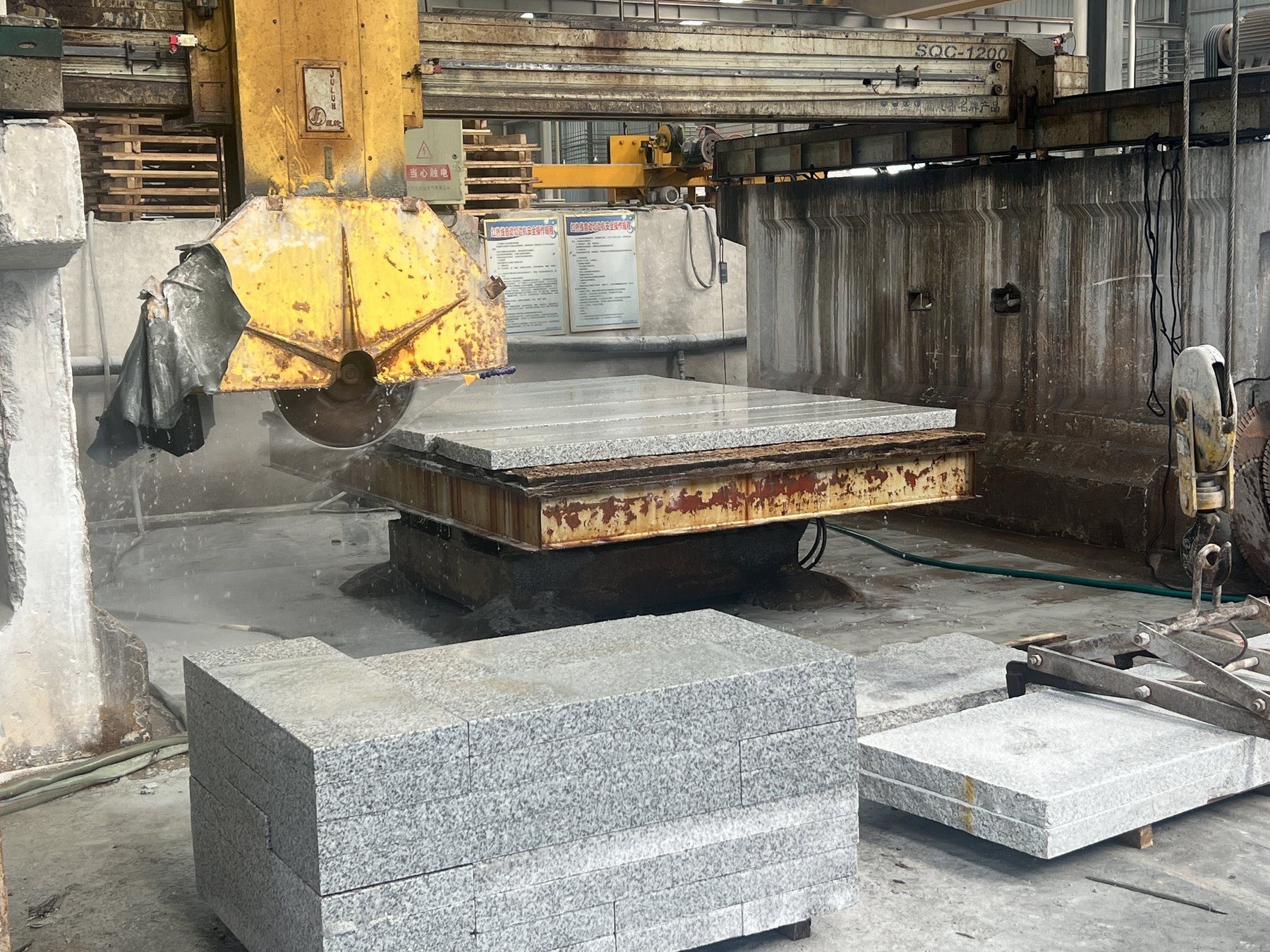
Most disputes between a granite importer and a supplier are not about colour. They are about millimetres. A panel that is two millimetres off thickness quietly destroys a level facade line, adds hours to bedding or rail adjustment, and turns a straightforward installation into a negotiation. The good news is that thickness and flatness problems are almost completely preventable – if the tolerances are agreed before the order and checked when the container opens. This guide sets out a practical incoming inspection routine for G603 white granite panels.
Agree the Tolerances Before the Order, Not After the Container
Every cut-to-size order should carry three numbers on the purchase order itself: length tolerance, width tolerance and thickness tolerance. For calibrated panels a commercial standard of plus or minus 1 mm on thickness is normal and achievable on a modern line; sawn, uncalibrated material is usually quoted at plus or minus 2 mm. Length and width on cut-to-size panels should hold to plus or minus 1 mm. If the purchase order is silent, the supplier will assume the loosest reading, and the installer will discover it panel by panel. Writing the numbers down costs nothing and removes the argument later.
What Flat Actually Means
Flatness is the deviation of the panel face from a true plane – not the same thing as thickness. A panel can be exactly 20 mm thick and still bow like a dish. On site, flatness shows up as lippage: adjacent panels whose faces sit at different heights, which catches raking light and reads as a wavy wall. The practical site test is a straightedge laid across the face in several directions, with feeler gauges to measure the gap. For calibrated G603 panels, anything beyond about 1 mm under a one-metre straightedge should be flagged before installation, not after.
Sampling a Container Without Unpacking Everything
Nobody should unload forty crates to find one problem. A sensible incoming inspection samples around five per cent of the panels, spread across the container rather than taken from the first crate on the tail lift. Open crates from the front, the middle and the back of the container, since damage and variation are rarely evenly distributed. If the sampling rate follows an AQL 2.5 logic – the norm in stone export inspection – a two-hundred-panel order needs roughly eight panels measured in full, with a visual check of every opened crate for chips and breakage.
The Five-Measurement Routine
For each sampled panel, the whole check takes about two minutes:
- Thickness at five points. A digital caliper at each corner and the centre. Record all five; a single reading hides saw wander.
- Length and width. Tape or caliper, both diagonals too – a parallelogram panel with correct side lengths will not stack or grid.
- Flatness. Straightedge across the face in both diagonals, feeler gauges in the gaps.
- Edge straightness and squareness. An engineer’s square against each edge; chipped arrises or out-of-square cuts go on the report.
- Finish check. Flamed or honed faces inspected under raking light for wheel marks and burns.
Write the panel number and crate number against every reading. A claim supported by a table of measurements is settled in days; a claim supported by “some panels were thick” is not settled at all.
Defects You Will See, and What They Mean
Thickness that varies along one edge points to saw wander or blade wear – a machine issue the factory can correct. A panel bowed across its length usually comes from poor storage or uneven support in the yard, not from the saw. Edge chips cluster where packing was loose or bands overtightened. G603’s natural grey-and-white speckle varies block to block; that is geology, not a defect, and it is why serious buyers approve a reference sample per batch and hold suppliers to that batch.
Claims That Get Resolved
Photograph the measurement in place – caliper on the panel, gauge under the straightedge – and send crate numbers, panel counts and the packing list together, within the claim window your contract specifies. Suppliers respond to evidence, not adjectives. Replacement panels for a genuine dimensional claim should come from the same batch, which is only possible when the supplier controls the blocks and keeps batch records instead of buying on the open market.
Why Quarry-Direct Supply Makes Inspection Easier
Our G603 white granite is cut and calibrated at our own operation in Suizhou, Hubei, from blocks we quarry ourselves. Before shipment we issue batch photographs and a dimensional inspection record against the tolerances on your purchase order, so the container arriving in your yard should match the file you approved – not approximately, but panel by panel. When a claim is justified, replacement material is cut from the same batch run, not from a different mountain.
Importing G603 on a regular programme? Send us your panel schedule and tolerance sheet, and we will return a dimensional inspection report and batch photographs with every shipment quotation.
Deja una respuesta