





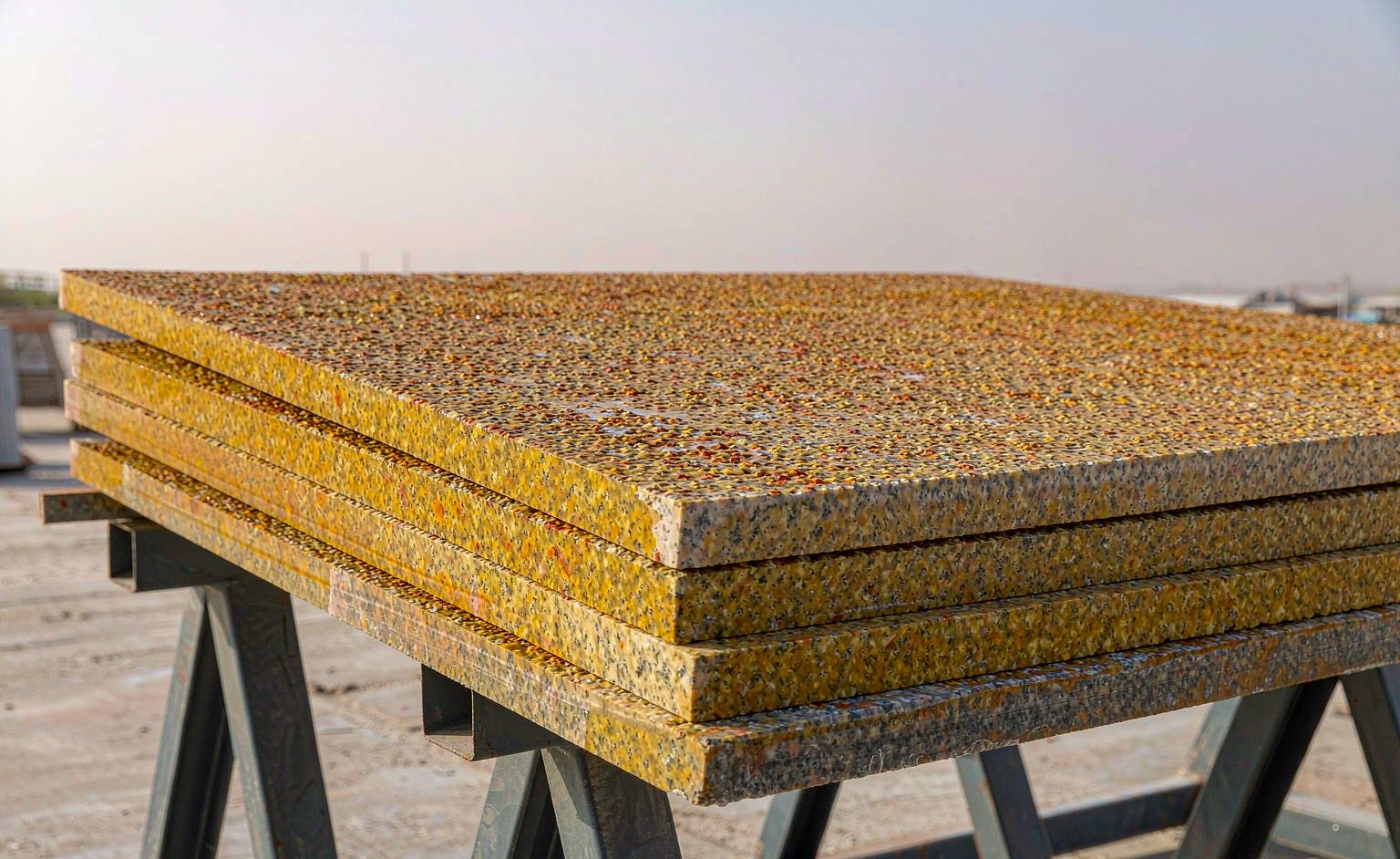
When a facade is specified for Dubai, Riyadh, Ho Chi Minh City or any coastal city in between, the material has to survive three things at once: relentless UV, wide daily temperature swings, and air that carries salt or fine dust. On paper, many stones look suitable. In practice, the ones that disappoint usually fail on absorption, thermal movement or finish retention – not on strength. G682 golden granite, quarried in Suizhou, Hubei, performs well against exactly these failure modes. Below is how it behaves in hot climates, and what a specifier should confirm.
Low absorption is the number that decides coastal performance
The single most useful figure for a seaside facade is water absorption. G682 tests at 0.4 percent or below, firmly in the low-porosity band for natural granite. Why does that matter near salt water? When a porous stone absorbs saline moisture and then dries out in the sun, dissolved salts crystallise inside the pores. This salt weathering causes pitting, crumbling edges and staining on softer stones after a few seasons. A dense granite with absorption under 0.4 percent simply does not take up enough moisture for this cycle to do serious damage. The practical step for specifiers: ask for the actual test report, not the catalogue claim, and confirm the figure follows a recognised method such as EN 13755 or the equivalent Chinese standard.
Thermal movement: large panels, wide swings, manageable
A west-facing elevation in the Gulf can swing from around 25 degrees Celsius at dawn to well above 60 degrees Celsius on the panel surface in the afternoon. Granite expands and contracts at roughly the same order of magnitude as reinforced concrete – the movement is real but easily absorbed by correctly designed joints and anchors. G682 has the headroom for this duty: density around 2.7 g/cm3, compressive strength 110-150 MPa, Mohs hardness 6 to 7. In specifications this means three things: open joints sized for the calculated movement (typically 6 to 10 mm), anchors that allow differential movement between stone and substructure, and no rigid grouting that would turn joints into crack lines. The stone rarely fails in these conditions – the fixing details do.
Surface finish: what survives sun, dust and hand contact
In hot, dusty environments the finish choice is a performance decision. For external walls, a flamed or bush-hammered G682 surface keeps its grip and colour under strong UV; the warm golden tone with rust-toned patterning fades far less visibly than darker basalts or some engineered materials. Honed finishes work well on covered walkways and semi-external areas. Full polish is better reserved for interiors – lobbies, lift cores, feature walls – where reflectivity is an asset and the surface is not exposed to sand-laden wind. A note for facilities teams: a flamed panel that collects dust can be restored with plain water and a stiff brush or a low-pressure wash, no chemicals needed.
What the freeze-thaw figure tells you about desert climates
G682 is certified to more than 200 freeze-thaw cycles. Gulf and Southeast Asian projects will never test that literally – frost is not the enemy there – but the number is still informative. Freeze-thaw resistance is an indirect measure of internal soundness: a stone that survives hundreds of such cycles has a tight, homogeneous grain structure with minimal micro-cracking. That same structure is what resists thermal shock when a monsoon shower hits a 60-degree panel, or when desert nights turn cold after a scorching afternoon. Specifiers who want an extra check can request a soundness or thermal shock test report; quarry-direct factories can usually supply these on request.
Five questions to put to the factory before you approve the material
For an architect or facade consultant, climate durability is won at the sourcing stage. Five points worth confirming with a G682 supplier before approval:
- Current water absorption and density test reports for the exact quarry batch, not historical averages.
- Whether blocks are selected at the quarry face and sawn in the same factory
- colour consistency on long facade programmes depends on this.
- The proposed finish for each elevation and exposure, with flamed samples in particular.
- Panel thickness against the anchor system: 30 mm is standard for ventilated facades, thicker for high-wind zones.
- A site mock-up covering several slabs, so joints, colour range and finish can be judged as installed.
One stone, one source, full traceability
G682 golden granite comes from our own quarry in Suizhou, Hubei province, and every step from block selection to flamed finish, packing and container loading is handled by the same team. For hot-climate projects, absorption figures, colour batches and finish quality can therefore be traced back to a single source – exactly the documentation climate-driven specifications demand. Send us your drawings and panel schedule for technical data, finish samples and a per-square-metre quote.
Leave a Reply