





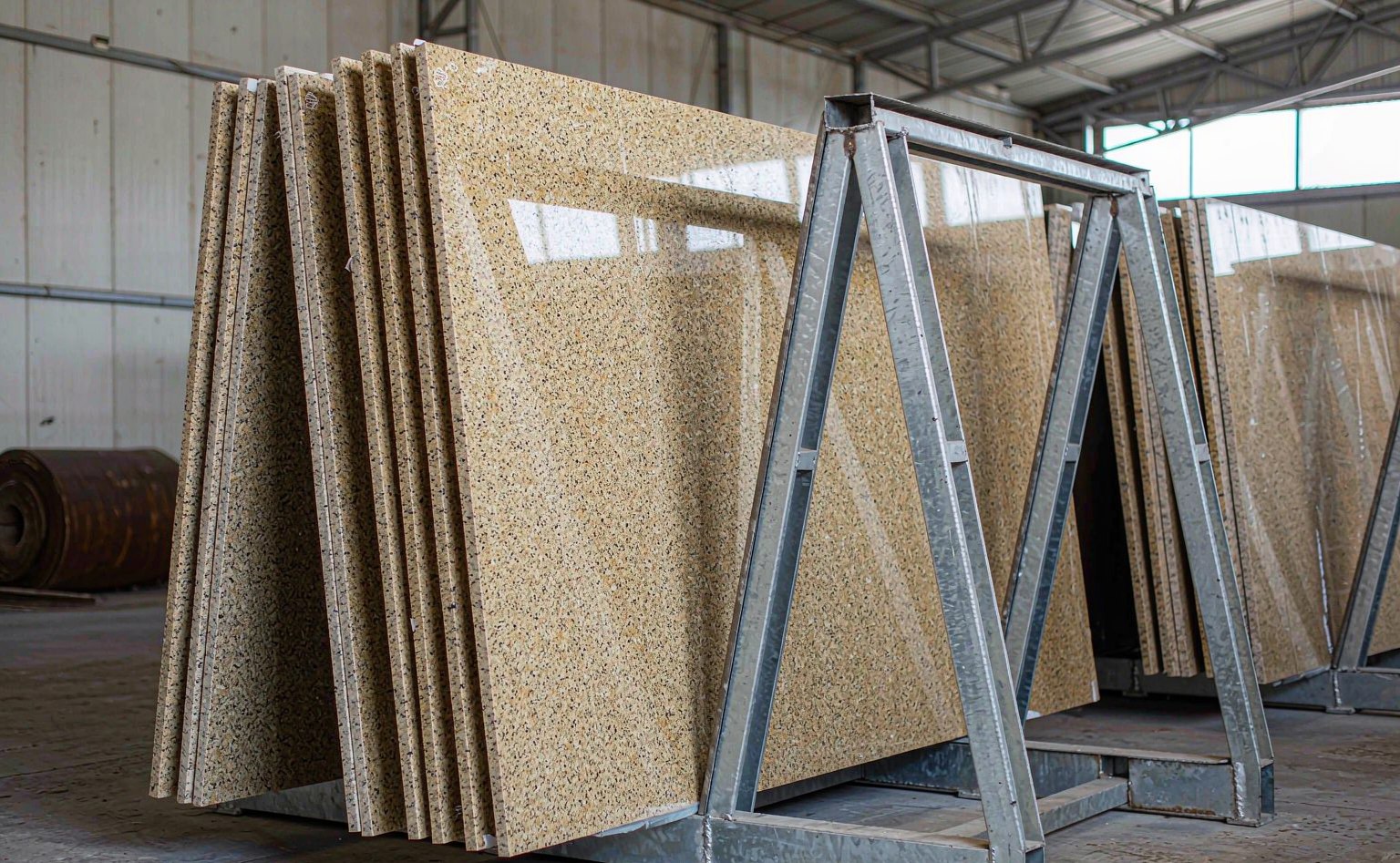
Buy the same G682 golden granite in two different formats and you can end up with two very different project outcomes. Large slabs give a fabrication workshop freedom; cut-to-size panels arrive ready to install. Importers, wholesalers and stone fabricators ask us almost every week which format they should order – and the honest answer depends on how much processing happens on your side of the ocean. This guide breaks down what each format contains, where it saves money, and where it creates work.
The Three Supply Formats for G682
G682 golden granite from Suizhou, Hubei leaves our factory in three main formats:
- Large slabs – gang-sawn and finished (polished, honed or flamed) full slabs, commonly around 2400 x 1200 mm and larger depending on block size, in 16, 18, 20 and 30 mm thicknesses. This is the raw-material format: you buy surface area and cut what you need.
- Standard tiles – fixed modular sizes such as 600 x 600, 600 x 300 and 300 x 300 mm, calibrated and ready to lay. Best for flooring and paving layouts that follow a grid.
- Cut-to-size project panels – panels produced to your shop drawings: specified lengths, thicknesses, edge profiles, and drilled or slotted anchor holes where the fixing system needs them.
Why Fabricators Tend to Buy Slabs
For a stone workshop, slabs are flexibility. Cutting your own pieces from 20 or 30 mm slab lets you nest parts efficiently, pull window sills, copings and column cladding out of offcuts, and keep that offcut stock for small orders that would otherwise be uneconomical. Slabs also make batch control easier: reserving slabs from one block batch keeps the warm yellow background and fine black speckle of G682 consistent across everything you cut that month. And when a client changes a detail late, you re-cut from stock instead of re-ordering from China. The trade-off is real, though: slabs only pay off if you have sawing capacity, edge-processing equipment, skilled labor and somewhere to store offcuts. If your workshop lacks any of those, buying semi-finished material simply moves cost from our invoice to your floor.
When Cut-to-Size Is the Smarter Buy
Cut-to-size wins wherever the installation grid is fixed and site labor is expensive. For a curtain-wall or rainscreen facade, panels cut to the grid – with anchor holes positioned to the millimetre – arrive on site ready to hang. Nothing gets re-worked on scaffolding, and waste stays in the factory where it is cheap, not on the site where it is expensive. Factory production also makes quality control simpler: thickness tolerance, flatness and edge detail are checked panel by panel before packing, which is far easier than policing tolerances on a busy site. For high-rise cladding and large public projects, this is the format most contractors ultimately choose, even though the unit price per square metre is higher than raw slab.
The Numbers That Matter in Either Format
Format changes geometry, not quality. Whether you buy slabs or finished panels, the specification baseline for G682 stays the same: density around 2.7 g/cm3, compressive strength of 110-150 MPa, water absorption at or below 0.4% – which is what carries the freeze-thaw performance on northern elevations – Mohs hardness of 6-7 for trafficked floors, and GB 6566 Class A radioactivity, which places no restriction on interior use. Ask any supplier, including us, to put these figures in writing with the offer, and to hold thickness and flatness tolerances to the standard written into your contract.
One Quarry, One Batch, Both Formats
Because we cut G682 directly from our own quarry in Suizhou, Hubei, slab orders and cut-to-size orders can be pulled from the same block selection. That matters when a project mixes formats – for example, 30 mm slabs supplied to a local fabricator while we produce cut-to-size copings and facade panels for the same development. Batch photos and samples are approved as a golden sample before mass production starts, and packing follows the format: slabs travel in bundles on A-frames, while cut-to-size panels are crated in export plywood crates with foam separators for ocean freight.
A Quick Checklist Before You Order
- Count the processing your side can realistically do: sawing, edge work, drilling.
- Map the installation grid from the shop drawings before choosing a format.
- Ask for slab photos or samples from the actual production batch, not stock photos.
- Confirm thickness, tolerance and edge details in writing on the proforma.
- Match the packing format to how the container will be handled at destination.
If you send us your drawings or a slab list, we will quote the order both ways – slab supply and cut-to-size – so you can compare landed cost, not just unit price. That comparison, more than anything else, decides which G682 format is right for your workshop.
Leave a Reply