





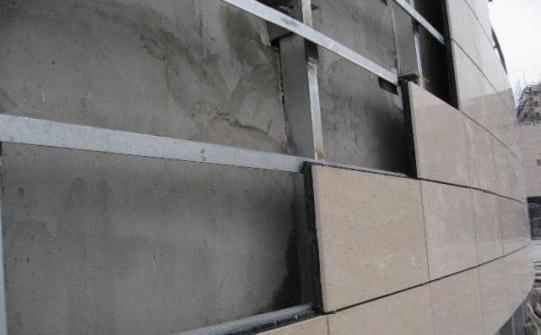
Specifying the right granite is only half the job. How you fix it to the structure determines whether your facade survives 50°C summer heat, coastal salt spray, and occasional sandstorms — or starts leaking and delaminating three years after handover. For G682 golden granite cladding in Middle East and Southeast Asian projects, the two dominant systems are mechanical dry hanging (also called point-fixing or hook fixing) and structural silicone glazing (SSG). Here is how they compare in real project conditions.
How Mechanical Dry Hanging Works
In a mechanical dry-hung system, each granite panel is supported by stainless steel brackets (typically 304 or 316 grade) fixed to the backing structure with anchor bolts. The panels rest on lower support brackets and are held at the top by adjustable hooks. A 4–8 mm drainage gap is left between panels, and the rear of the facade functions as a ventilated rainscreen cavity. Panels can be removed individually for maintenance without disturbing adjacent units.
Best for: Large-format 30mm facade panels, high-rise buildings, coastal locations where salt spray is a concern, and projects where future access to the backing structure may be needed.
How Structural Silicone Glazing (SSG) Works
In an SSG system, granite panels are bonded to aluminium extrusion frames using high-strength structural silicone sealant. The mechanical fixings are hidden behind the panel, creating a seamless, jointless appearance on the exterior face. The silicone cures over 7–21 days depending on humidity and temperature, and the bond strength must be tested on sample coupons before full installation.
Best for: Low-rise buildings and feature walls where a clean, monolithic aesthetic is prioritized over future panel replacement. It is less common for granite — more typical for glass curtain walls — but some architects specify it for lobby feature walls and podium cladding.
Thermal Performance in Hot Climates
This is where the choice matters most for Gulf projects. A ventilated dry-hung cavity acts as a thermal buffer: hot air rises and exits through the top vent, keeping the inner wall surface significantly cooler than an unventilated adhered system. Measurements on Dubai residential towers show ventilated granite facades reducing heat gain by 20–30% compared to direct-bonded stone, which translates directly to lower HVAC loads.
SSG systems, by contrast, create a near-sealed joint that traps heat between the stone and the structure. In 50°C ambient temperatures, trapped cavity air can exceed 70°C, accelerating sealant degradation and risking thermal stress cracking in the granite. For this reason, most Gulf facade consultants specify open-joint ventilated systems for stone cladding above the podium level.
Wind Load and Structural Safety
Tornado-zone and high-wind locations (parts of Saudi Arabia, Oman, and cyclone-prone Southeast Asia) demand careful load calculations. Mechanical hanging systems transfer wind loads directly through stainless steel anchors into the structure, with each panel engineered independently. SSG relies on the silicone bond — which weakens over 15–20 years under UV exposure — and is harder to inspect without removing panels.
For G682 granite at 30mm thickness, mechanical systems are typically engineered for wind loads up to 2.5 kPa with safety factors of 2.5:1. The brackets and anchors should always be specified as 316 stainless steel in coastal zones; 304 will show rust staining within 5–7 years near the sea.
Maintenance and Panel Replacement
On a dry-hung facade, a cracked or stained panel can be unhooked and replaced in a few hours — typically from a swing stage or rope access. On an SSG facade, removing a bonded panel is a destructive process that often damages adjacent units and requires re-curing the silicone, which can take weeks. For multi-building residential compounds where replacement panels may be needed 10 years into operation, the repairability advantage of mechanical fixing is decisive.
Cost Comparison
Mechanical dry hanging is generally 15–25% cheaper per square meter than SSG when you account for the aluminium frames, specialized silicone, and extended curing time. The stainless steel brackets are a small fraction of total facade cost, and installation is faster because there is no silicone cure cycle to wait through. For budget-conscious contractors across Vietnam, Malaysia, and the Gulf, mechanical fixing is the default specification.
Our Recommendation for G682 Projects
For the vast majority of G682 golden granite facade applications — residential towers, commercial podiums, villa compounds, and boundary walls — a ventilated mechanical dry-hung system with 316 stainless brackets is the technically and economically sound choice. Reserve structural silicone for interior feature walls and low-rise accent facades where the seamless appearance justifies the premium. At Suizhou Xuhui Stone, we supply G682 panels cut and drilled to match your chosen bracket system, with pre-fabricated anchor holes and layout drawings included in every container. Send us your facade shop drawings for a technical recommendation on your next project.
Leave a Reply