





Most buyers first meet G682 golden granite as flat material: slabs on a rack, tiles on a pallet, pavers in a crate. Yet a growing share of landscape and municipal tenders now call for shaped work – radius steps that sweep around a planter, bullnose copings along a pool, curved kerb lines that follow a roadway. If your drawing set contains a single radius dimension, you are no longer buying flat stone; you are buying fabrication. This guide explains what G682 can realistically be fabricated into, and what to send the factory so curved elements arrive cut right first time.
Why G682 Handles Profiled Work Well
Fabrication quality starts with the stone itself. G682 – also sold as golden granite or yellow rust granite – comes from the quarries of Suizhou, Hubei, where our own production runs from quarry block to finished piece:
- Density of about 2.7 g/cm3 and compressive strength of 110-150 MPa give profiled edges the toughness to survive handling, installation and public-traffic wear.
- Water absorption at or below 0.4 percent keeps profiled arrises stable through wet-dry cycles – important for pool surrounds and plazas.
- Freeze-thaw resistance beyond 200 cycles supports outdoor steps, kerbs and copings in cold regions.
- Mohs hardness of 6-7 means the stone machines cleanly: a bullnose edge holds its line, and a flamed surface stays textured underfoot.
The stone also carries a GB 6566 Class A classification, so shaped pieces can be used indoors as freely as outdoors. And because blocks are selected at the quarry face, batch color stays consistent – a real advantage for curved work, where a mismatched segment shows from every angle.
Cobblestones and Setts: Small Units, Strict Sorting
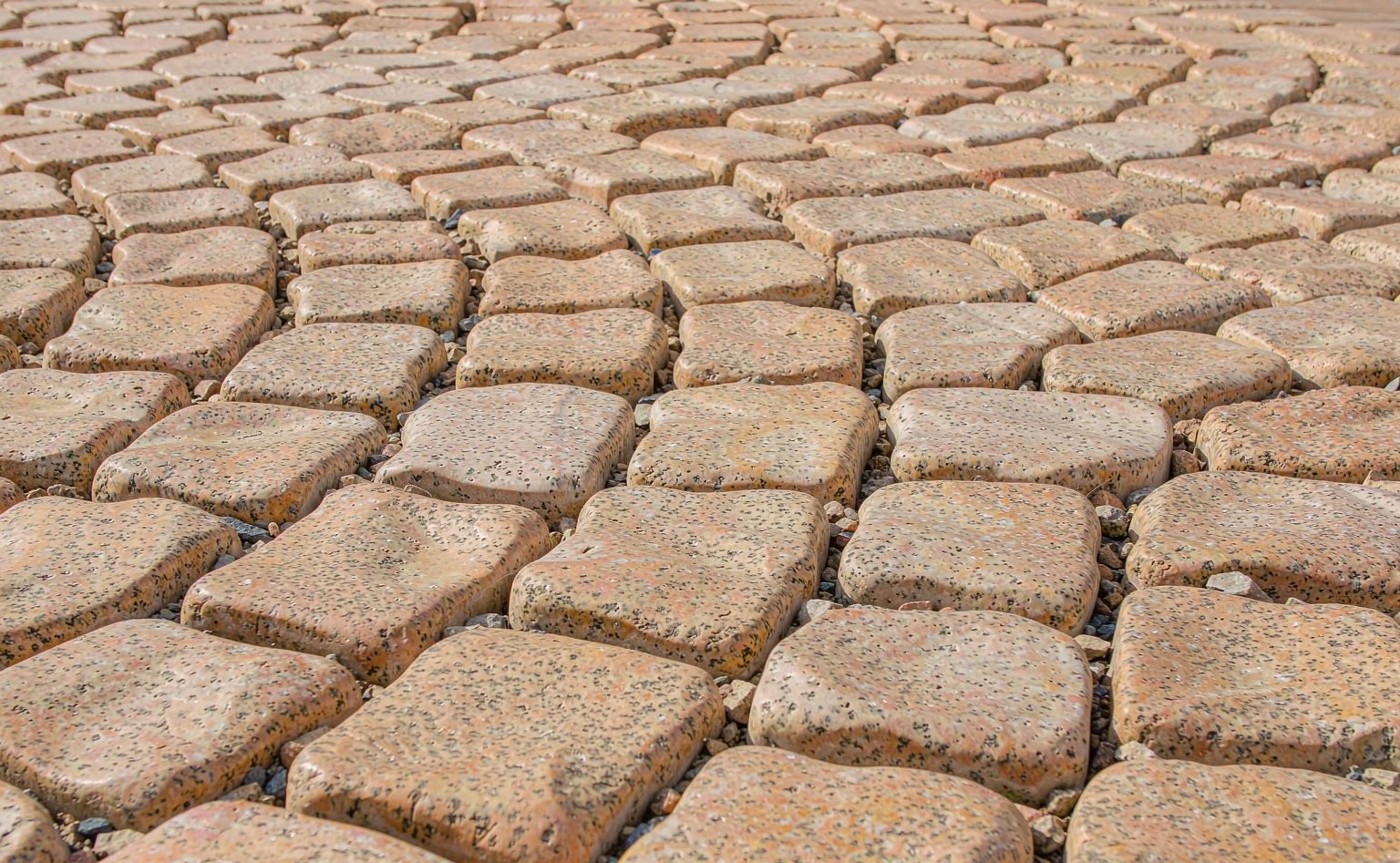
Cube setts are the most common shaped product in this category. Standard formats run 8x8x8 cm and 10x10x10 cm, tumbled for a softened, aged feel or hand-split for a sharper traditional face. They can be supplied loose for laying in fan or arc patterns, or pre-mounted on mesh to speed up installation. For plazas and pedestrian streets, a flamed or tumbled top is preferred for slip resistance; sawn sides keep the joints tight.
Radius Steps and Curved Kerbs
Radius steps are cut from thicker block so the tread keeps full section strength after the curve is milled. The walking surface is typically flamed for grip while the riser stays sawn or honed for a crisp line. Plan curvature and step width follow the setting-out drawing, so the run matches the planter or stair sweep exactly. Curved kerbs work the same way: radius, cross-section and length cut to drawing instead of forcing straight units into an arc with wide joints.
Bullnose Copings for Pools, Planters and Parapets
Coping is where profile vocabulary matters. The routine options are:
- Full bullnose – a fully rounded edge, comfortable to touch and forgiving of chips; the default for pool copings and benches.
- Half bullnose – a rounded top with a square underside, keeping a slimmer shadow line on walls and planters.
- Eased edge with chamfer – a modern, minimal profile that suits contemporary plaza detailing.
A typical pool coping combines a flamed top for wet-area grip with a honed or polished rounded edge, in 30 mm or 50 mm thickness. With low absorption and dense texture, G682 performs reliably around chlorinated water and splash zones.
Curved Cladding Segments and Waterjet Cutting
On the building side, G682 also takes curved facade work. Large-radius walls are normally achieved with wedge-cut segments that read as a smooth curve once installed, while true curved panels are machined from thick block for feature columns. Waterjet cutting adds another dimension: logos, lettering and decorative grilles cut with clean edges that need no secondary dressing.
What to Send the Factory for an Accurate Quote
Shaped work is quoted from information, not guesses. For the tightest quotation, prepare:
- Setting-out drawings in PDF plus editable DXF or AutoCAD files, with radii and levels marked.
- The edge profile for every exposed arris (bullnose type, chamfer size, or a hand sketch if there is no code).
- Finish per face – for example flamed tread, sawn riser, honed edge.
- Quantities per element type, and the tolerance you expect on radius and length.
- Anchor or bedding details if the pieces are mechanically fixed.
A golden sample approval before mass production closes the loop: the client signs off on color, finish and profile on a physical piece, and the batch is matched against it.
Talk to a Supplier That Cuts Its Own Stone
Custom fabrication rewards suppliers who control the chain. Suizhou Xuhui Stone produces G682 golden granite from its own quarry through its own workshop, so radius steps, copings, setts and curved segments are quoted and scheduled by the same team that selects the blocks. Send us your drawing set and quantities – we will return a piece-by-piece fabrication proposal, and samples can be couriered for approval before you commit the order.
Deja una respuesta