





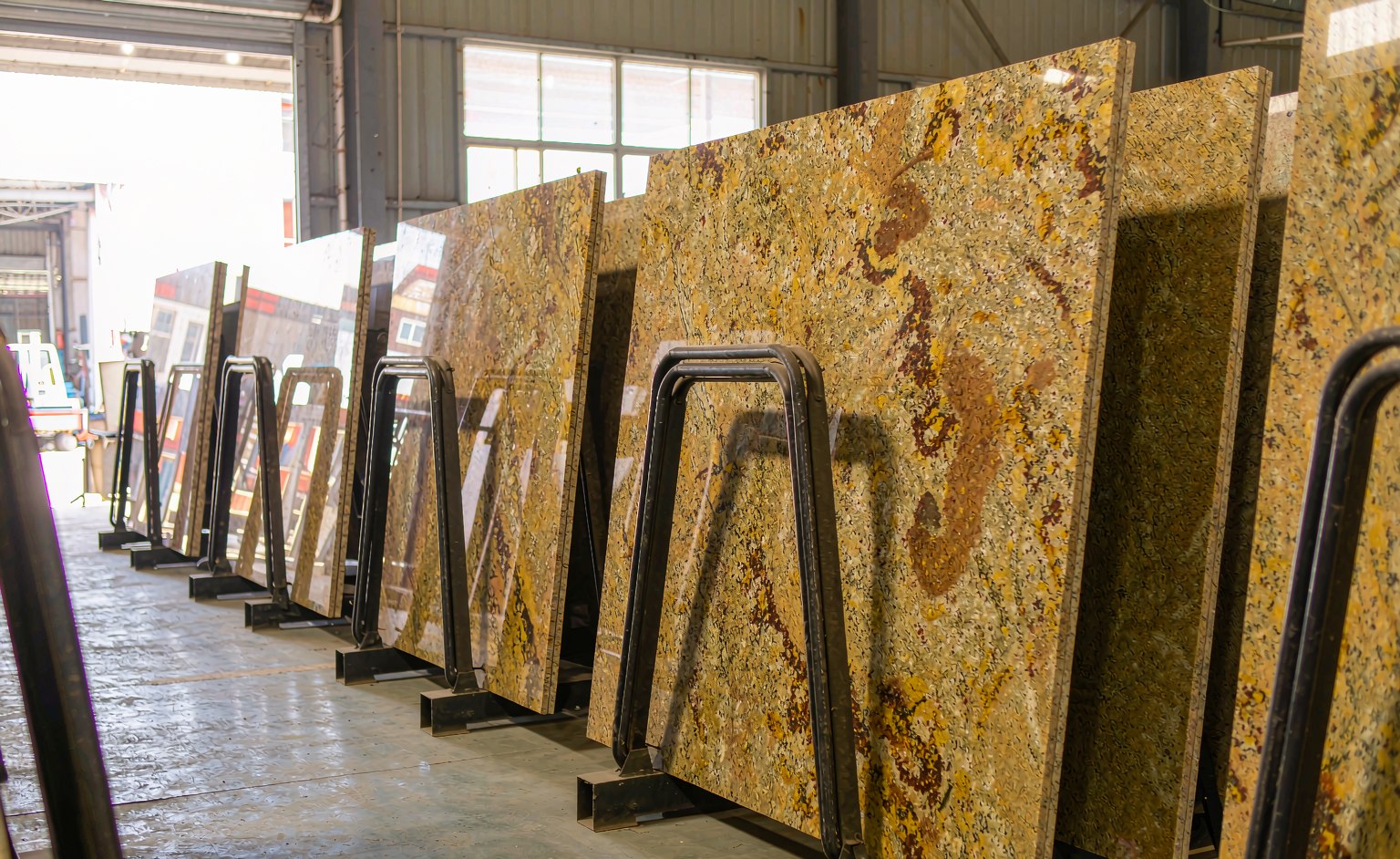
Re-cladding is one of the few facade decisions an owner will live with for thirty years, and one of the easiest to get wrong. The visible result – new stone on an old frame – hides a chain of structural, water-management and programme decisions settled long before the first panel was fixed. This guide sets out what owners and their consultants should establish before committing to a G682 golden granite re-cladding project.
When Re-Cladding Is the Right Answer
Re-cladding competes with three alternatives: patch repair, over-cladding, and full replacement. Patch repair is cheapest but only works when the failure is local; over-cladding adds load and changes the building’s geometry. The triggers that justify a full re-clad are consistent:
- Panel failure rather than surface wear. Cracks at fixing points, bowing, spalling edges or staining that returns after cleaning all point to a system at the end of its life.
- Water ingress behind the cladding. Once water travels behind panels, the problem is the cavity and the flashing line, not the stone face.
- A dated appearance. Elevations repaired piecemeal rarely hold a consistent colour, and a mixed facade is hard to lease.
- A regulatory or performance upgrade. Fire performance, thermal bridging and seismic detailing requirements have moved on; a new cladding zone is the moment to meet them.
Survey the Building Before You Specify the Stone
The most common cause of re-cladding cost overruns is a specification written before anyone opened up the existing facade. A proper survey establishes four things: substrate and embed plate condition, the as-built panel module rather than the original drawings, the pull-out capacity available at each anchor position, and the state of any steel or rail system being retained. Opening three representative bays – corner, mid-elevation, parapet – usually reveals more than a full visual inspection from a scaffold.
Weight, Thickness and the Real Load Path
New stone has to be carried by an old structure designed for a different panel. G682 has a density of roughly 2.7 g/cm3, so a 30 mm panel weighs close to 80 kg per square metre and a 25 mm panel around 67 kg. If the original facade used thinner material or a different stone, the increase must be checked against the slab edges and the building’s lateral system – not assumed. Where the structure is tight, a 25 mm panel with undercut anchors often resolves the constraint without changing the design intent.
Keep the Building Weathertight While You Work
Re-cladding an occupied building is a sequencing exercise as much as a construction one. Work proceeds elevation by elevation, with temporary weathering installed the same day panels come off and removed only when the new cavity, insulation and flashing are complete. Two rules keep water out: never open more facade than can be closed before the next forecast rain, and keep the drainage plane continuous across each temporary joint so water still reaches the weeps while the elevation is part open.
Matching Stone Across a Single Elevation
A re-clad elevation reads as one surface, so colour and veining consistency matters more than on a new-build where balconies and glazing break up the facade. Buying from a single quarry batch, and reserving three to five per cent for future repairs, is the difference between a wall and five deliveries. Because G682 comes from our own quarry in Suizhou, Hubei, we can hold a batch open and ship replacement panels from the same block run months later – something a trader buying on the open market cannot promise.
Programme, Cost and Whole-Life Value
Access and labour – scaffold, mast climber, out-of-hours working – account for most of the cost, and the stone is a smaller share than owners expect. Squeezing the panel price while extending the programme is a false economy. Single-batch supply, consistent thickness tolerance and pre-drilled fixing patterns keep installation at the planned rate, which protects the access budget. Whole-life value follows: 110 to 150 MPa compressive strength, water absorption at or below 0.4 per cent, freeze-thaw resistance above 200 cycles and Mohs hardness of 6 to 7 mean the new skin should not need another intervention within the life of the mortgage.
Specifying the Stone With Confidence
Owners need documentation as much as stone. G682 is Class A under GB 6566 for radioactivity, which clears it for any building type, including residential and interior lobby applications. As a quarry-direct manufacturer we issue batch photographs, thickness and flatness inspection records, and cut-to-size shop drawings for each elevation, so consultant approval and site sequence rest on the same numbers.
Planning a facade replacement and need a supplier who can hold a batch? Send us your elevation drawings, panel module and target programme, and we will confirm formats, thickness options and a phased delivery plan that matches your scaffold sequence.
اترك تعليقاً