





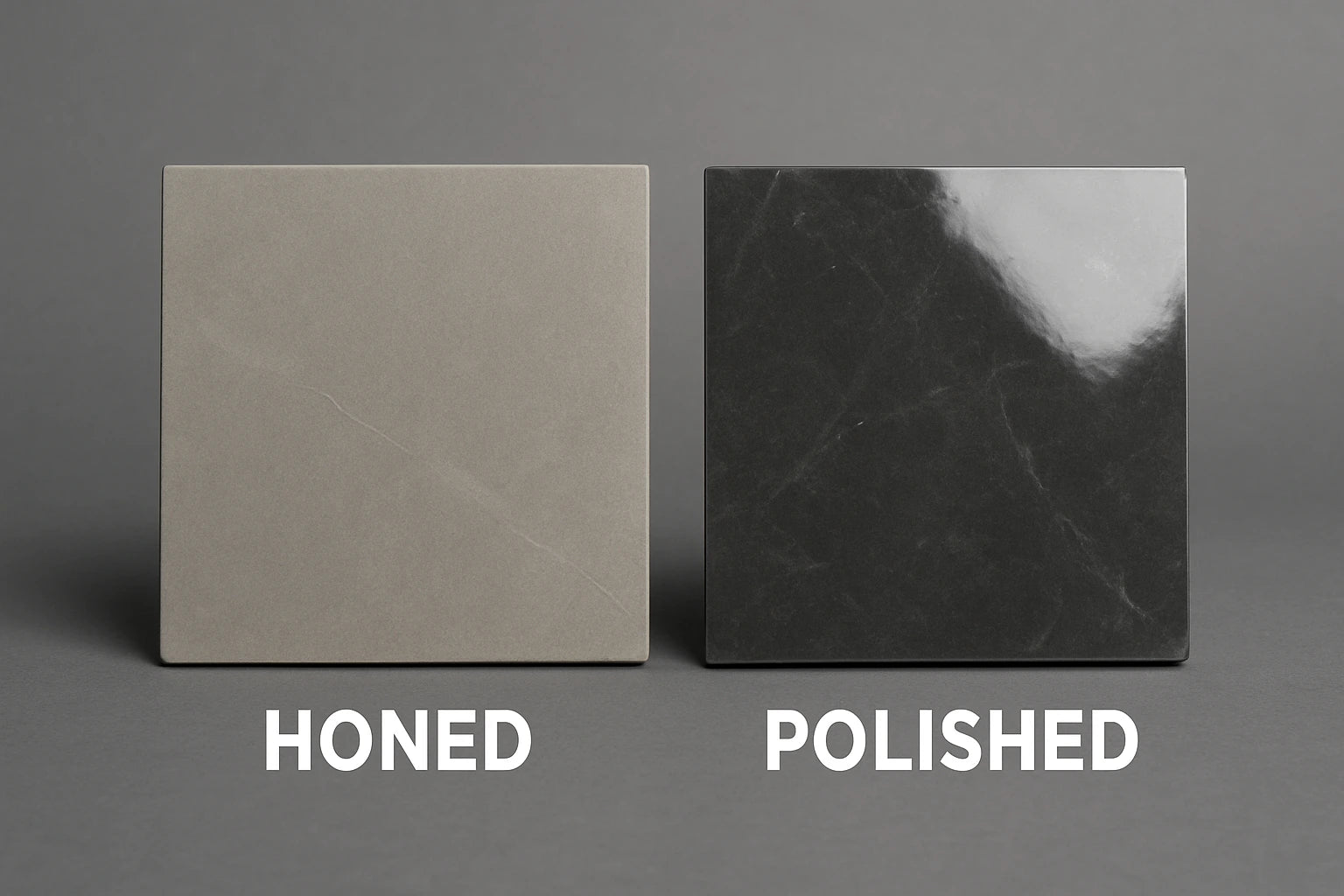
The same G682 golden granite can look dramatically different depending on its surface finish. A flamed finish reads as a matte, textured warm sandstone. A polished finish glows like a premium beige marble. A honed finish sits somewhere between. For facade projects in the Middle East and Southeast Asia, the wrong finish choice doesn’t just look off — it affects slip resistance, heat absorption, maintenance frequency, and long-term color stability. Here is how the three standard finishes compare for exterior G682 applications.
Flamed Finish: The Exterior Default
Flaming (also called flaminged or heat-finished) passes the granite surface over a high-temperature oxy-acetylene flame, causing the quartz and feldspar grains to pop and create a rough, textured surface. The finish is non-slip even when wet, hides fingerprints and water spots, and naturally mutes the gold tone of G682 into a warmer, sandier beige.
Why it dominates exterior cladding: The rough texture diffuses sunlight rather than reflecting it, reducing glare on adjacent buildings. It also hides minor surface abrasion from sandstorms and foot traffic. Flamed G682 is the default specification for most Saudi, UAE, and Qatari residential tower facades because it performs reliably in 50°C heat without thermal reflection problems. Texture depth is typically 1–2mm, and the surface is slip-rated R11 for public-facing plinths.
Watch out for: Low-quality flaming can overheat the slab and cause micro-cracks along the edges. Reputable factories control flame speed and plate temperature to keep edge integrity, and every batch is checked for edge chipping after flaming.
Honed Finish: Smooth but Not Glossy
Honing grinds the surface flat but leaves it matte — no buffing or polishing compound is used. The result is a smooth, satin-smooth surface that still shows the natural golden flecking of G682 without mirror reflection. Honed G682 is a popular choice for podium levels, entrance lobbies, and interior feature walls where the architect wants a refined look without the glare of polished stone.
Where it works best: Ground-floor cladding where the stone is seen at close range, reception desk surrounds, column cladding, and covered walkways. Honed surfaces show color more accurately than flamed — you see the true G682 golden tone rather than the muted sandy version. Because the surface is denser than flamed, honed G682 also absorbs slightly less water, which helps in dusty environments where airborne grime sticks to rough textures.
Watch out for: Honed exterior surfaces show foot traffic scuffing more visibly than flamed, and in wet conditions they are less slip-resistant (roughly R10). For open-air stair treads and ramp areas, specify flamed or add anti-slip strips.
Polished Finish: Best Left for Interiors
Polishing uses progressively finer diamond pads and polishing powder to produce a mirror-smooth, reflective surface. Polished G682 shows its richest golden color and tightest grain pattern. It is breathtaking on reception floors, feature walls, and elevator lobbies.
Why we rarely recommend it for exterior facades: A polished surface in direct Middle Eastern sun acts like a mirror ‑ reflecting glare onto neighboring properties and creating heat-island effects. More critically, polished granite’s slip resistance drops dramatically when wet, making it a safety hazard on exterior walkways and entry steps. The polished surface also etches over time from acid rain and desert dust, losing its shine within 3–5 years on an exposed facade.
When it does work: Covered entrance canopies, shaded podium walls, and interior columns — anywhere the stone is not exposed to direct rain and sun. For interior applications, polished G682 is an elegant, cost-effective alternative to more expensive imported yellow marbles.
How the Finish Affects Color Consistency
This is a practical point many architects miss. The same block of G682 will look different depending on finish: flamed mutes the gold and lightens the overall tone; polished deepens the gold and darkens it; honed sits in between. When your project mixes finishes across different elevations — for example, flamed on the tower and honed on the podium — the samples must be approved from the same block range so the color transition reads as intentional, not mismatched. We supply sample pairs (flamed + honed from the same slab) for exactly this reason.
Cost and Lead Time Differences
Flaming is the fastest and most economical finish — it is a continuous production line process. Honing adds a few days per batch because it requires multiple grinding passes. Polishing is the most labor-intensive, typically adding 10–15% to the slab cost and extending lead time by 5–7 days on a standard container order. For large facade projects where budget is tight, specifying flamed across all exterior elevations is the standard cost-saving move.
Our Recommendation
For 90% of G682 facade projects — residential towers, boundary walls, parking podiums, and exterior cladding — specify flamed finish. Reserve honed for covered ground-floor levels and feature columns. Keep polished strictly for interiors. At Suizhou Xuhui Stone, we produce all three finishes in-house from our own G682 quarry, so you can order mixed finishes from the same block range with guaranteed color matching. Request our finish sample kit — flamed, honed, and polished G682 chips from the same block — to compare on your project site.
اترك تعليقاً